The experience
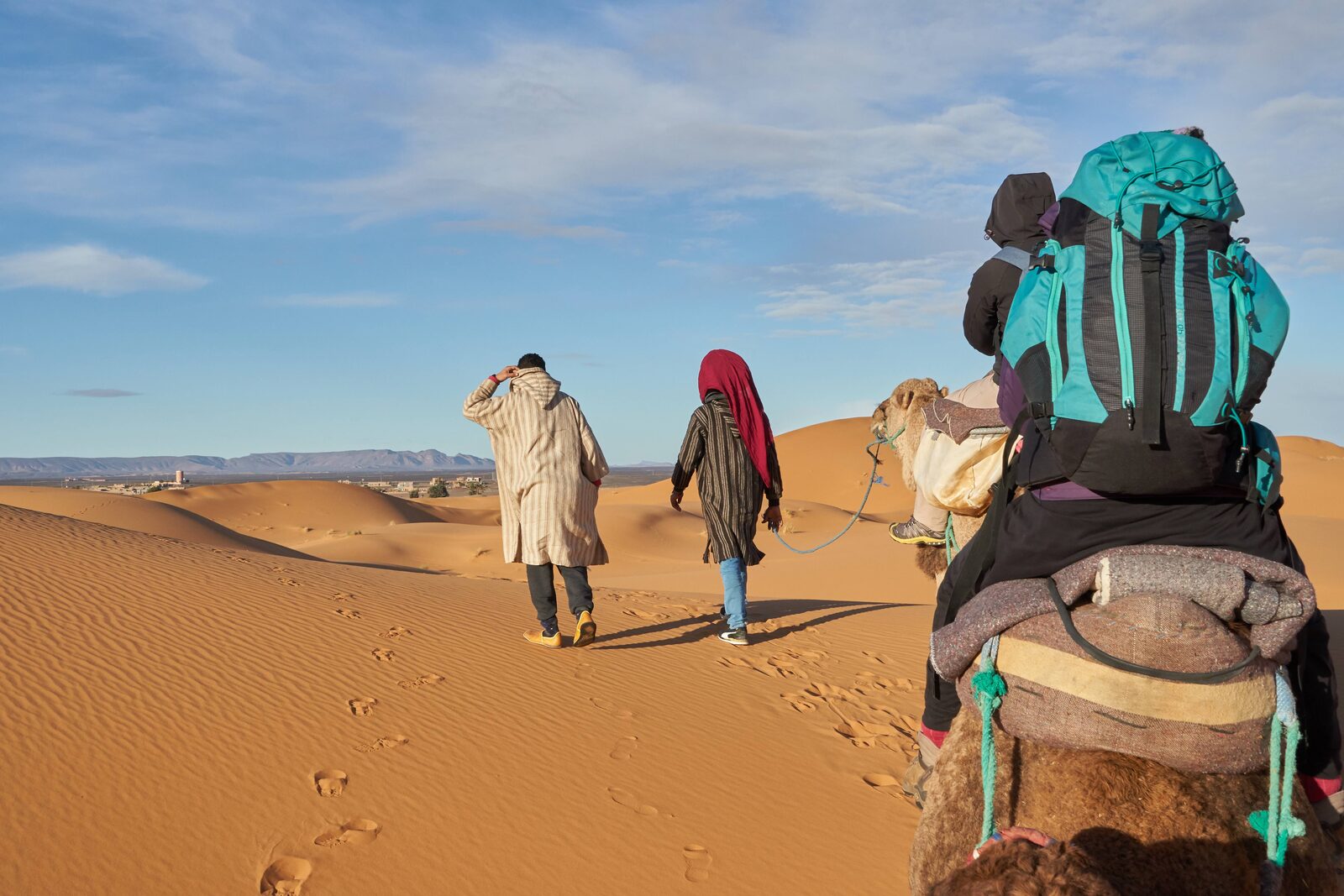
The length of the whole country, top to bottom, and then the part almost nobody sees. After Chefchaouen, Fez and two nights at Erg Chebbi we cross the Jebel Saghro into the Draa Valley and Zagora, come back through Ouarzazate on the old Telouet road, drop south over the Tizi n'Test to Taroudant and the Souss, reach the Atlantic at Taghazout, and work north to Essaouira before finishing in Marrakech.
- Two nights at Erg Chebbi
- Draa Valley, Zagora and Tamegroute
- Telouet kasbah and the old pass road
- Taroudant, Tiout and Paradise Valley
- Essaouira and a guided Marrakech day
Full itinerary, day by day
Tangier → Tetouan → Chefchaouen
An hour in Tetouan's Andalusian medina on the way east, then the climb south into the Rif through cork oak and terraced smallholdings.
Chefchaouen by mid-afternoon, which leaves the blue lanes their best hours. The town belongs to itself again once the Tangier coaches have gone, and the square under the kasbah walls is where to spend the evening.
Chefchaouen → Volubilis → Meknes → Fez
An early walk through the upper medina, the kasbah and its garden, the ras el maa, and the climb to the Spanish Mosque for the view back over the roofs.
South through Ouezzane into olive country. Volubilis in the early afternoon, with its mosaics still in the floors they were laid in, then Meknes for Bab Mansour and the Heri es-Souani granaries, and into Fez for the night.
Fez, guided day on foot
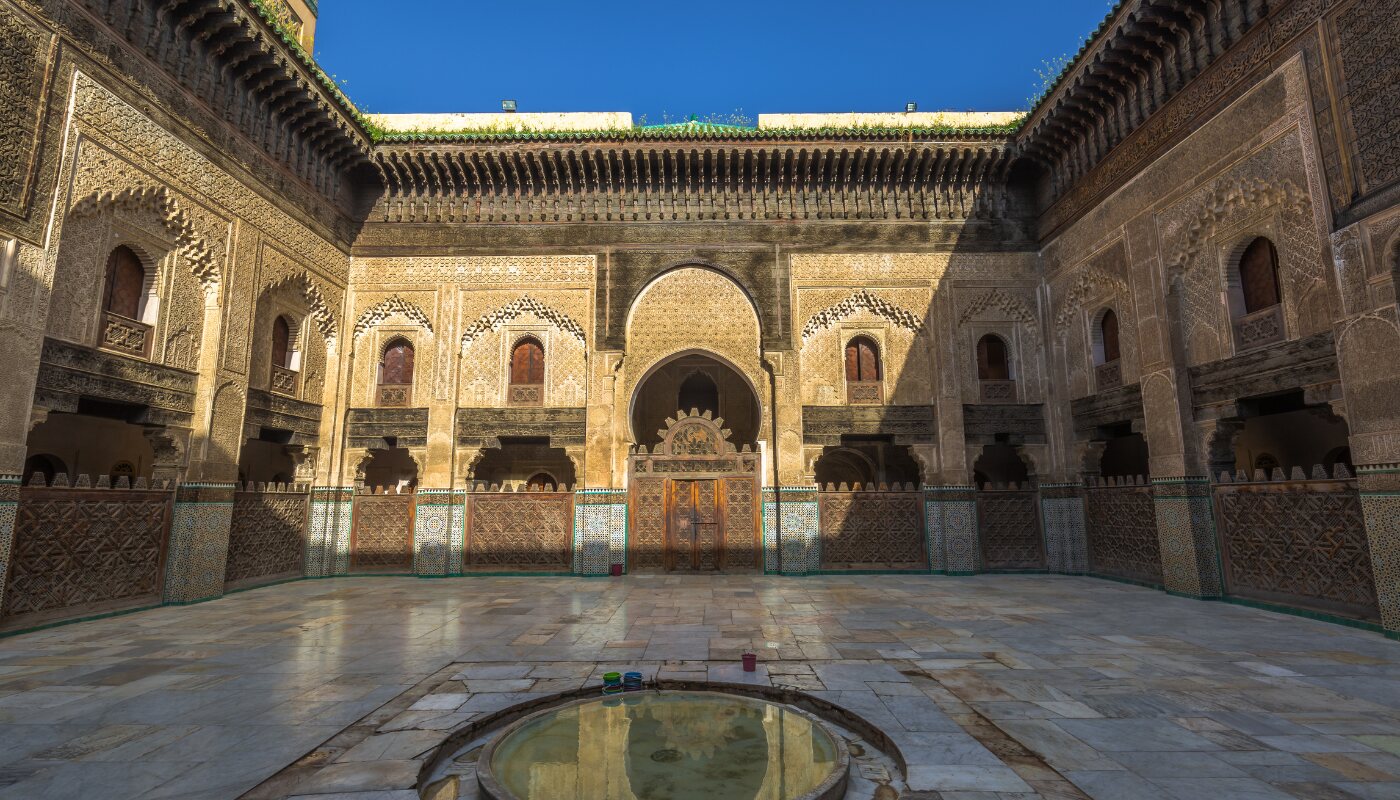
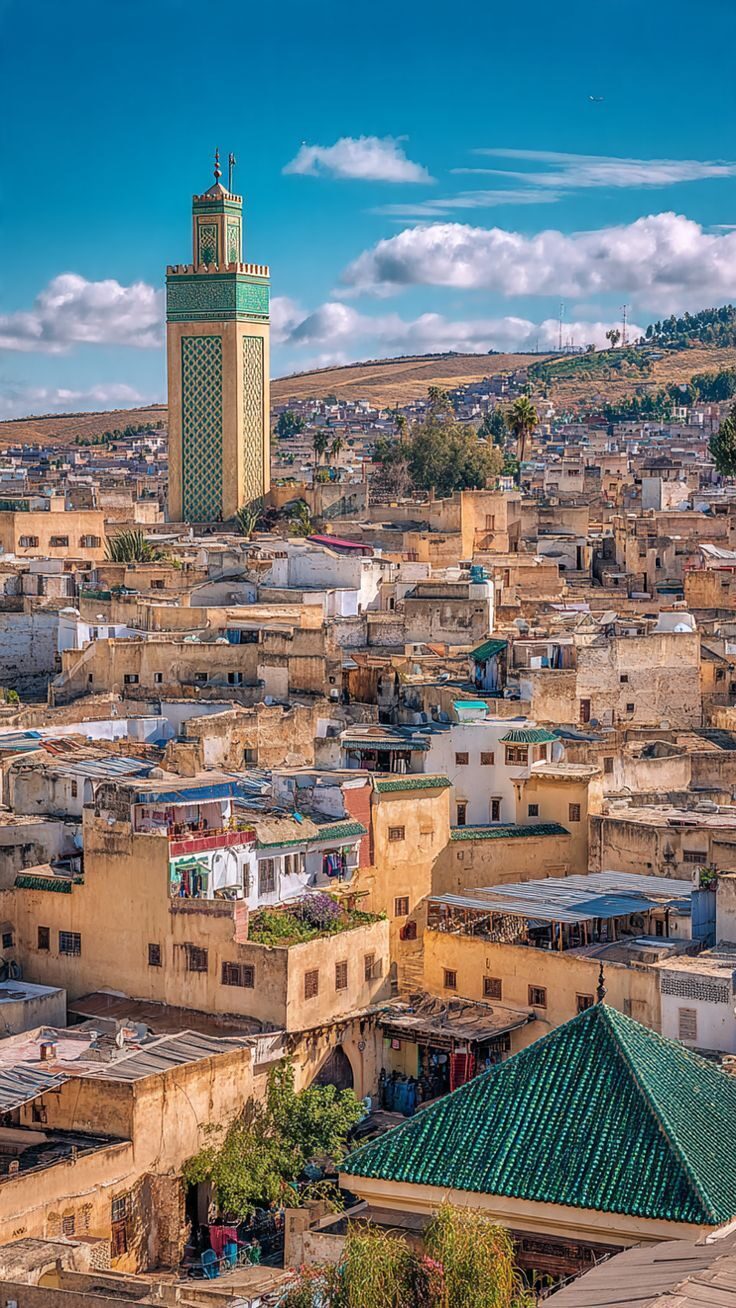
The whole day in Fez el-Bali with a licensed guide: Bab Boujloud, the Bou Inania madrasa and its water clock, the Attarine madrasa, Al-Qarawiyyin and its ninth-century library, and the Nejjarine fondouk.
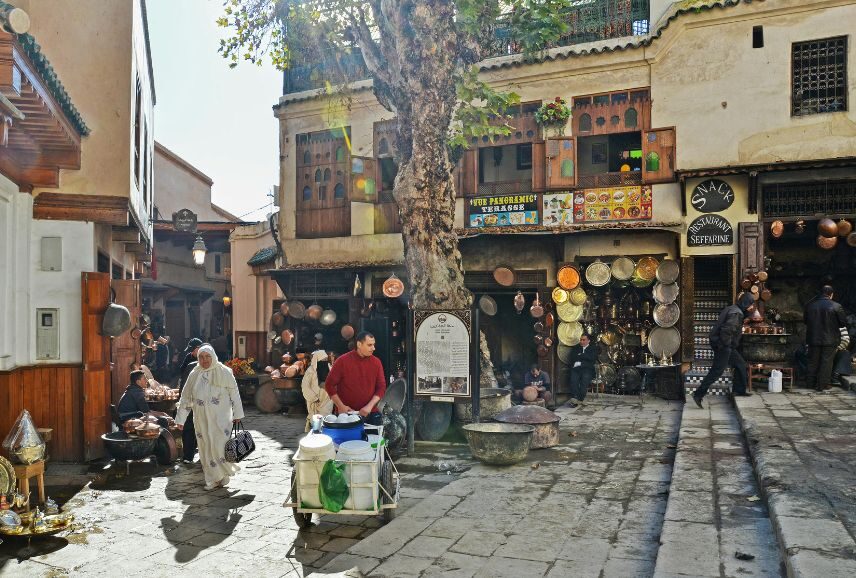
The afternoon is the working medina — the Chouara tanneries, the brass square at Seffarine, the weavers' lanes, and the zellij workshops beyond Bab Ftouh. Sunset from the Merinid tombs on the ridge above the city.
Fez → Ifrane → Midelt → Ziz → Merzouga
The long drive south, and one of the great road days in Morocco. Ifrane at 1,665 metres, the Azrou cedar stand with its Barbary macaques, and the high plateau under the Jebel Ayachi.
Over the Tizi n'Talghemt and into the Ziz, a belt of date palms running tens of kilometres between red cliffs with ksour built back into the rock. Erfoud for the fossils, Merzouga by late afternoon, camels into Erg Chebbi at sunset, and a night at camp in the dunes.
Merzouga, full day in the desert
Sunrise from the dune, breakfast and a shower, then the desert at walking pace. Khamlia for Gnawa music in the village that keeps it as ritual, nomad families on the hammada, and madfouna baked under the sand for lunch.
The afternoon covers the black desert east towards the frontier, the fossil beds and Dayet Srji if there is water in it. Second night in the sand — having two means the sunrise is not also a departure.
Merzouga → Rissani → Nkob → Agdz → Zagora
This is where the circuit leaves the usual road. West from Rissani on the Alnif route, across the southern flank of the Jebel Saghro, which is volcanic, black and almost unpopulated, with table mountains standing off the plain.
Nkob has more kasbahs in sight at once than anywhere else in Morocco — over forty of them — and we stop there before the Tizi n'Tinififft brings us down into the Draa at Agdz. The Draa is the longest river in the country and its valley is an unbroken palmery for a hundred and fifty kilometres. Night in Zagora.
Zagora → Tamegroute → Tinfou → Ouarzazate
Tamegroute in the morning, twenty minutes down the valley: a zaouia whose library holds Koranic manuscripts on gazelle parchment from the eleventh century, and a potters' quarter firing a distinctive green glaze, made with local copper, in kilns dug into the ground.
The Tinfou dunes are a little further on — small and isolated, nothing like Erg Chebbi, but they are the ones the old Timbuktu caravans actually passed. Then back up the Draa through Agdz and over the pass to Ouarzazate for the night.
Ouarzazate → Ait Benhaddou → Telouet → Marrakech
The Taourirt kasbah first thing, then Ait Benhaddou, where we cross the Ounila on foot and climb through the ksar to the granary at the summit for the view back down the valley.
Instead of the main pass we take the old Ounila road to Telouet, the kasbah of the Glaoui, who ran the whole south from here until 1956. Half of it is collapsing and the other half has painted cedar ceilings and zellij as fine as anything in Fez. The track rejoins the Tichka road and we come down into Marrakech in the evening.
Marrakech → Tizi n'Test → Taroudant
South out of the Haouz plain and up the Tizi n'Test, the older and narrower of the two High Atlas passes, built by the French in the 1920s on a mule track. We stop at Tin Mal, the twelfth-century Almohad mosque standing alone in its valley and one of the few in Morocco that non-Muslims may enter.
The pass tops out at 2,100 metres and the view south opens over the whole Souss plain to the Anti-Atlas. Down into Taroudant, which is walled in red earth for seven kilometres and gets called a small Marrakech, except that it is quiet and nobody is selling you anything. Night inside the walls.
Taroudant → Tiout → Taghazout
The ramparts first — you can circle them by caleche in about an hour — and then the two souks, Arab and Berber, which sell to the town rather than to visitors: spices, argan, silver, and second-hand everything.
Out to the Tiout palmery, where an oasis runs below a hilltop kasbah and you can walk or ride through the irrigation channels, then west across the citrus belt to the Atlantic. Taghazout is a fishing village that became a surf town and kept its scale. Night by the sea.
Taghazout → Paradise Valley → Essaouira
Paradise Valley in the morning, half an hour inland: a gorge in the argan hills with pools cut into the rock and palms in the bottom of it, best between late winter and early summer when the water is running.
Then the slow coast road north — headlands, argan trees with goats in them, the odd marabout tomb on a cliff. Essaouira in the late afternoon, inside the ramparts so the evening is on foot.
Essaouira, free day
No driving. The fish auction on the quay happens first thing with the blue boats behind it; the Skala de la Ville and its Spanish and Dutch cannon is a ten-minute walk; the thuya woodworkers are in the arcades under the ramparts.
Or go out of town: Sidi Kaouki is twenty-five minutes south, a long empty beach with reliable wind, and Diabat with its half-buried Dar Soltane is walkable from the port. Second night in Essaouira.
Essaouira → argan road → Marrakech → departure
A last morning by the sea, then inland through the argan forest with a stop at a women's cooperative where the kernels are cracked between stones and pressed by hand.
Marrakech by early afternoon, with a guided walk through the medina — the Koutoubia, the Bahia Palace, the Saadian Tombs and the souks — if your flight allows it, and the fifteen-minute run out to Menara airport whenever you need it.
Inclusions & exclusions
✓ Included
- Private air-conditioned vehicle & driver
- Accommodation in riads, hotels & desert camp
- Breakfasts and dinners as per itinerary
- Camel trek and a night under the stars
- Pickup and drop-off at hotel or airport
✕ Not included
- Lunches and extra drinks
- Monument and museum entrance fees
- Licensed city guides where requested
- Tips and personal expenses
A glimpse of the road
Along the way
Highlights
- Chefchaouen
- Erg Chebbi dunes
- Tamegroute library and kilns
- Taroudant ramparts
- Essaouira Skala
Comfort
- No marathon driving days
- Hand-picked riads along the route
- Stops whenever you ask for one
- Child seats and slower pacing on request