The experience
Twelve days is enough to stop treating the mountains as something you drive over. This circuit keeps the classic spine — Chefchaouen, Fez, Erg Chebbi, the gorges, Ait Benhaddou, Marrakech — and then adds a day in the High Atlas valleys above Marrakech and two nights on the Atlantic at Essaouira before coming home up the coast. Five of the twelve nights are second nights in the same bed.
- Chefchaouen and a guided Fez day
- Full desert day at Erg Chebbi
- High Atlas valley day from Marrakech
- Two nights inside the Essaouira ramparts
- Coastal return through El Jadida
Full itinerary, day by day
Arrive Casablanca
Airport pickup and an easy first day. The Hassan II Mosque, which stands partly over the Atlantic and took six thousand Moroccan craftsmen to finish, then the art deco quarter around Place Mohammed V and the Habous district, which was built in the 1920s as a new medina and is the pleasanter place to buy anything.
The afternoon is free for the Corniche and a first dinner by the water. If your flight lands late we simply shift the city tour to the morning of day two and start north afterwards.
Casablanca → Rabat → Chefchaouen
Rabat first: the Udayas kasbah with its blue and white lanes and Andalusian garden, the Hassan Tower, and Chellah, where a Merinid necropolis sits inside the shell of Roman Sala Colonia and the storks have the minaret.
Then four hours north and inland. The motorway crosses the Gharb, the road turns at Ouezzane, and the last stretch climbs into the Rif. Chefchaouen is reached in the late afternoon, which leaves the best hours of the day in the blue medina before dinner.
Chefchaouen → Volubilis → Meknes → Fez
A slow morning in Chefchaouen — the upper lanes before the coaches, the kasbah garden, the ras el maa where the stream comes out of the mountain, and the climb to the Spanish Mosque for the view back over the roofs.
South after that through olive country. Volubilis in the afternoon with its mosaics in situ and Moulay Idriss white on the hill above, then Meknes for Bab Mansour and the granaries of Moulay Ismail, and into Fez for the night.
Fez, guided day
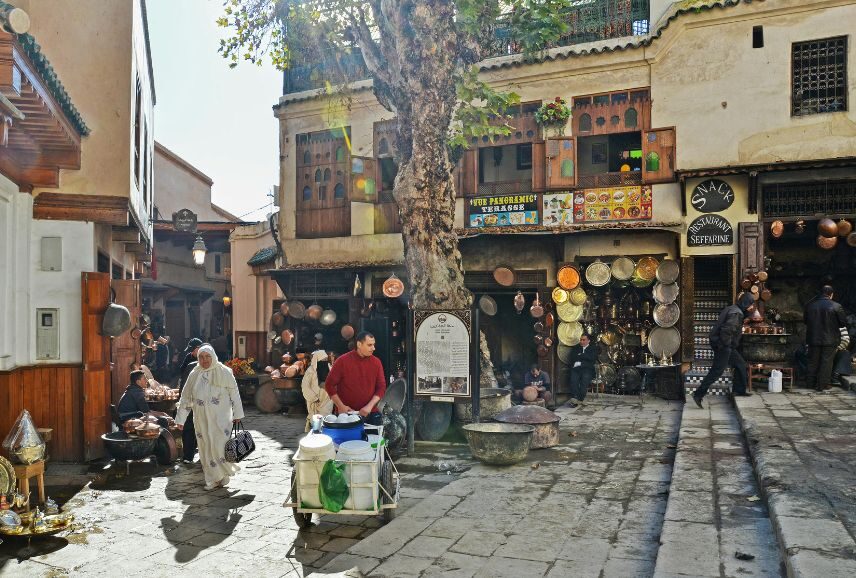
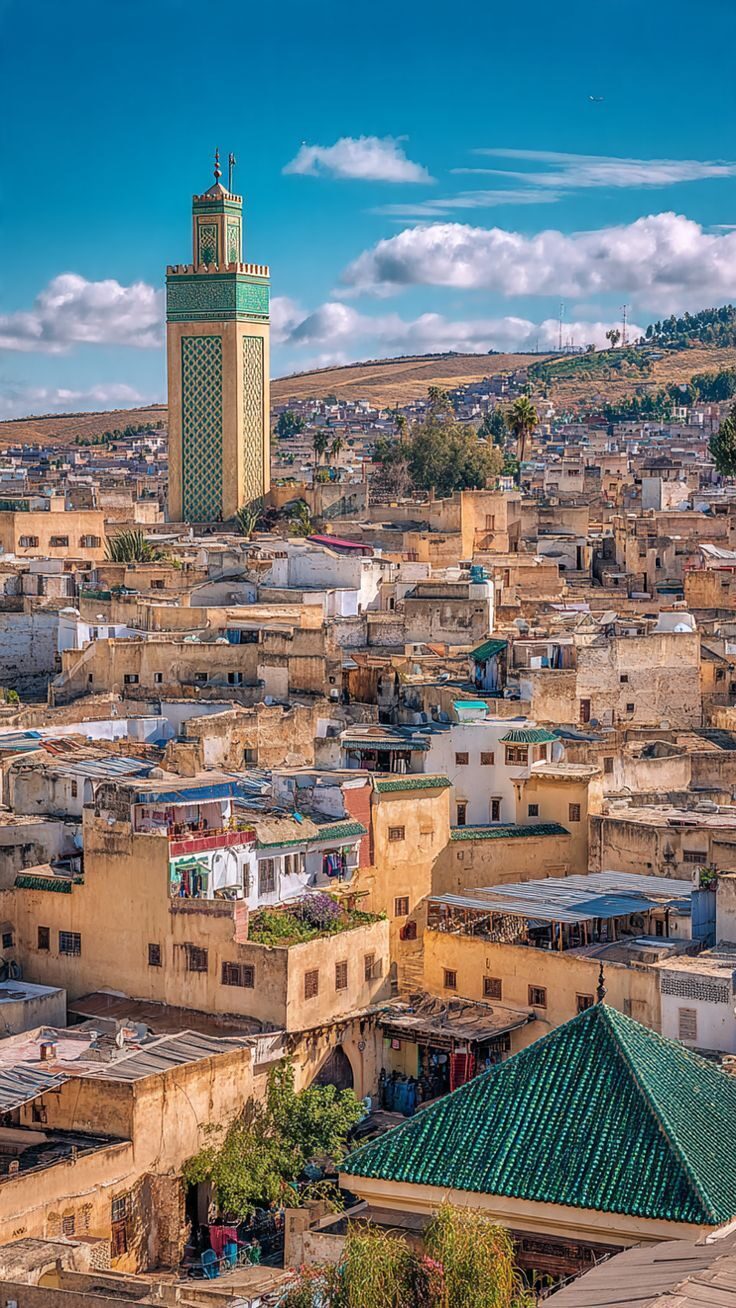
The medina on foot with a licensed guide, the whole day. Bab Boujloud, the Bou Inania and Attarine madrasas, Al-Qarawiyyin and its ninth-century library, the Nejjarine fondouk, and the Seffarine square where the brass is still beaten by hand.
The Chouara tanneries in the afternoon, dyed as they have been for a thousand years, then the ceramic workshops outside the walls where zellij is cut tile by tile with a hammer, and sunset from the Merinid tombs above the city.
Fez → Azrou → Midelt → Ziz → Merzouga
The crossing south. Ifrane, the Azrou cedar forest and the Barbary macaques, the high plateau to Midelt, and the Tizi n'Talghemt, after which the land turns red and the ksour appear.
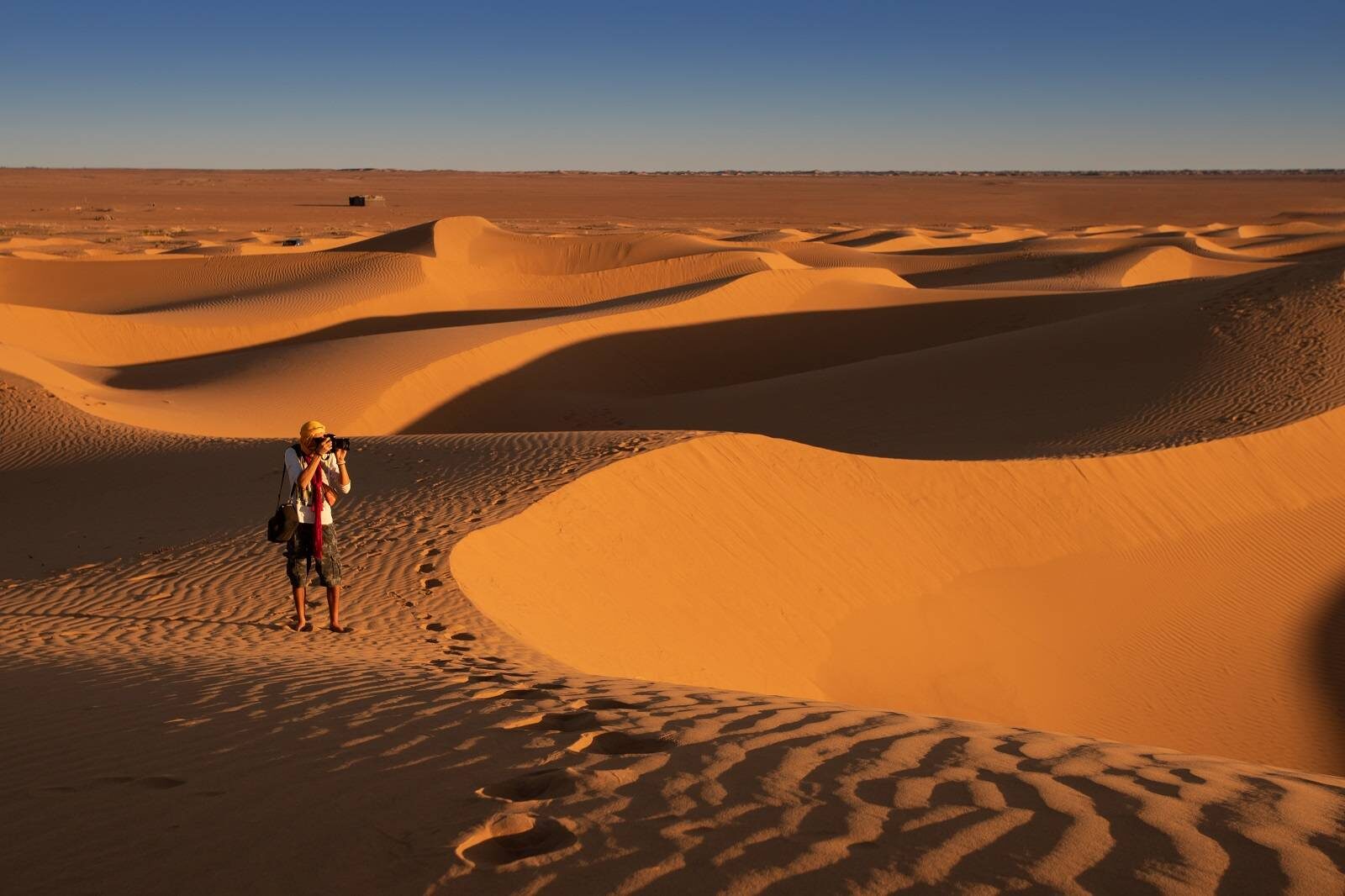
The Ziz Valley and its palm belt carry us down, Erfoud gives us the fossil workshops, and Merzouga arrives in the late afternoon. Camels into the erg at sunset, dinner at a Berber camp, and a sky with nothing in the way of it.
Merzouga, full day in the desert
Sunrise from the dune above camp, then breakfast and a shower, and the day spent in the desert rather than on the road out of it. Khamlia for Gnawa music in the village where it is still a ritual rather than a show, and madfouna baked in an underground oven for lunch.
In the afternoon, 4x4 across the black hammada, which is what most of the Sahara actually looks like, a visit to a nomad family if they are camped within reach, and Dayet Srji, the seasonal lake where flamingos turn up in spring. Second night at camp or in a kasbah at the edge of the dunes.
Merzouga → Rissani → Todra → Dades
Out of the sand and west. Rissani first, where Sijilmassa stood at the head of the gold caravans and the market is still the serious one for the whole Tafilalet, then Jorf for the khettara and their hand-dug shafts, and Tinghir above its palmery.
Todra Gorge in the afternoon, walked along the level floor under 300-metre walls. Then the climb into the Dades, the Tissdrine switchbacks in the evening light, and a night in a hotel set into the gorge.
Dades → Rose Valley → Skoura → Ouarzazate → Ait Benhaddou → Marrakech
Down the kasbah road with a stop in the Rose Valley at Kelaat M'Gouna and another in the Skoura palmery at Kasbah Amridil. Ouarzazate for lunch, the Taourirt kasbah, and the film studios if they appeal.
Ait Benhaddou in the afternoon, crossed on foot and climbed to the granary at the summit, then the Tizi n'Tichka over the High Atlas at 2,260 metres and the descent to Marrakech in the evening.
Marrakech, guided day
A guide and a day on foot: Koutoubia, Bahia Palace, Saadian Tombs, the Mellah and spice square, and the souks by trade. Lunch on a terrace and then the afternoon free for the Majorelle garden, the Yves Saint Laurent museum or a hammam.
In the evening, Jemaa el Fna changes character completely between six and eight — orange juice carts, storytellers, gnawa drums, food stalls that set up in twenty minutes — and it is best watched first from a roof and then from inside it.
Marrakech → Imlil and the High Atlas → Marrakech
An hour and a half south of the city the road ends at Imlil, a walnut-growing village at 1,740 metres below Jebel Toubkal, the highest mountain in North Africa at 4,167 metres. We walk from there — an easy two or three hours up the valley to Aroumd and the terraces, or further if you want it, with a mule for anything you would rather not carry.
Lunch is in a village house or at Kasbah du Toubkal on its spur above the valley. On the way back we can take the Ourika valley road instead and stop at the Setti Fatma waterfalls or at a Berber house for mint tea. Back in Marrakech by evening.
Marrakech → argan road → Essaouira
West through the argan forest, which grows nowhere else on earth at this scale, with a stop at a women's cooperative where the kernels are cracked and pressed by hand and you can taste the difference between the culinary and cosmetic oils.
Essaouira by early afternoon. It was Mogador, it was laid out by a French engineer for Sultan Mohammed III in the 1760s, and it is still a fishing port first: blue boats, a gull-loud quay, ramparts with Spanish cannon, and a grid of a medina that is easy to walk. Two nights here, so this afternoon is simply yours.
Essaouira → Oualidia → El Jadida → Casablanca
A last morning in Essaouira — the fish auction, the thuya woodworkers under the ramparts, the long beach south towards Diabat if you want the wind — and then north up the coast road.
Oualidia and its lagoon for lunch, oysters if the season suits, then El Jadida and the Portuguese cistern with its reflecting floor, and Casablanca in the late afternoon. We drop you at your hotel or at Mohammed V for an evening flight.
Inclusions & exclusions
✓ Included
- Private air-conditioned vehicle & driver
- Accommodation in riads, hotels & desert camp
- Breakfasts and dinners as per itinerary
- Camel trek and a night under the stars
- Pickup and drop-off at hotel or airport
✕ Not included
- Lunches and extra drinks
- Monument and museum entrance fees
- Licensed city guides where requested
- Tips and personal expenses
A glimpse of the road
Along the way
Highlights
- Chefchaouen blue medina
- Erg Chebbi dunes
- Ait Benhaddou
- Imlil and the Toubkal foothills
- Essaouira Skala and port
Comfort
- No marathon driving days
- Hand-picked riads along the route
- Stops whenever you ask for one
- Child seats and slower pacing on request